Alice Pays Bob - A journey through six generations of enterprise data architecture
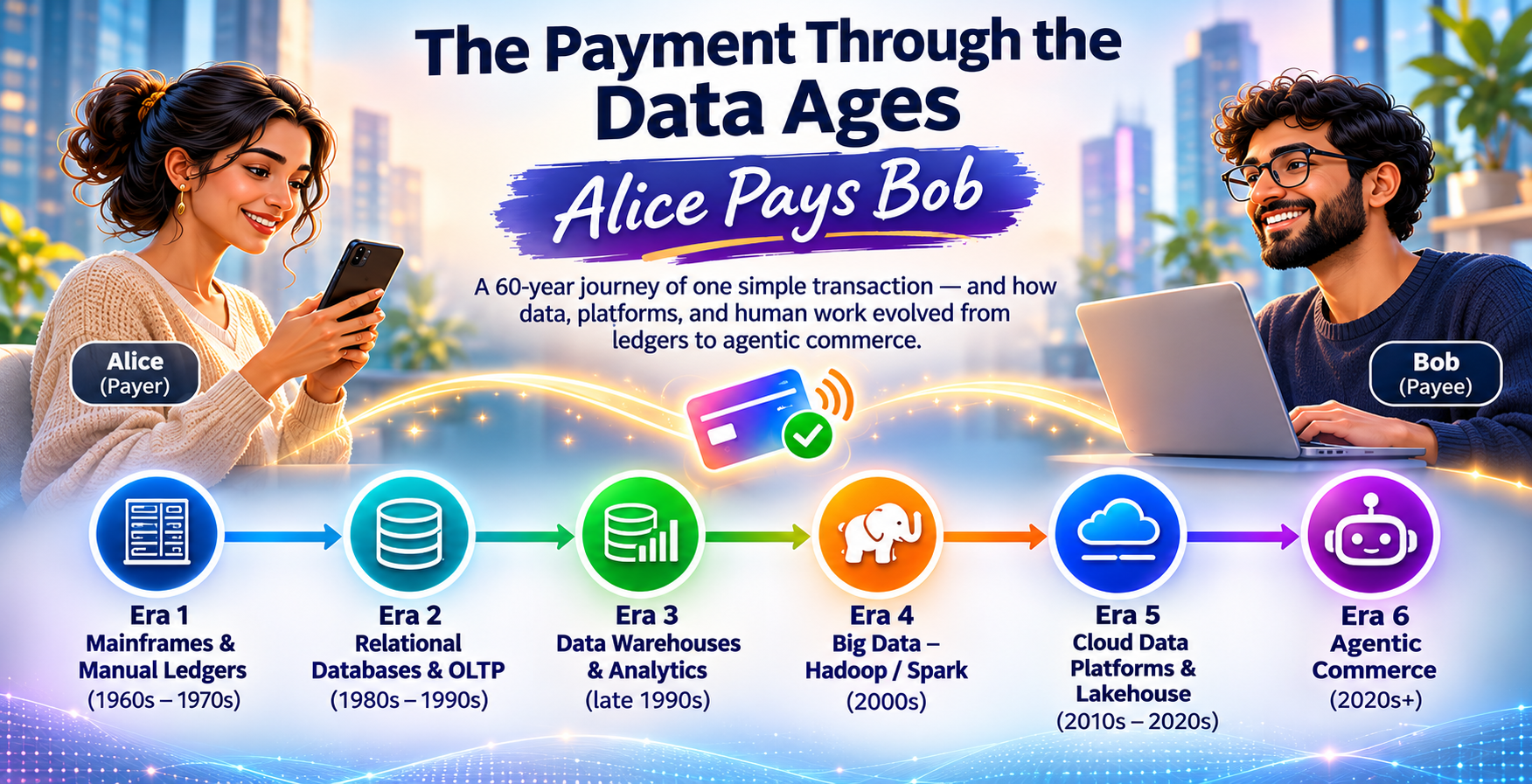
Alice Pays Bob --- A journey through six generations of enterprise data architecture
Series: Modern Data Engineering for the Agentic Era --- Part I
Modern Data Engineering for the Agentic Era: The Evolution from Data Platforms to Autonomous Intelligence
Imagine a simple transaction.
Alice wants to pay Bob ₹500.
Nothing complicated. Alice initiates the payment, Bob receives the money, and the transaction is recorded.
But have you ever wondered what happens behind this simple interaction?
How would Alice have paid Bob in the 1960s? What changed when relational databases arrived? How did data warehouses transform the way businesses understood transactions? What happened when Hadoop, Spark and cloud platforms entered the picture?
And, more importantly, what happens when Alice no longer needs to initiate the payment herself, but simply delegates the task to an AI agent?
The underlying business requirement has not changed. Alice wants to pay Bob.
But the technology, architecture, engineering practices, and human responsibilities behind that transaction have evolved dramatically.
Over the last six decades, we have moved through multiple generations of data platforms. Each generation solved limitations of the previous one, expanded what organizations could understand, and changed how people interacted with enterprise systems.
Let's explore this evolution through one simple story.
Alice pays Bob.
Era 1: Mainframes and Manual Ledgers (1960s--1970s)
When the transaction was more important than the insight
Let's go back to the 1960s.
Alice wants to send ₹500 to Bob. She visits her bank, writes a paper cheque, and hands it over to the teller.
The teller verifies the details, checks the account balance, and passes the transaction to the back-office operations team.
Behind the scenes, a centralized mainframe system processes the transaction.
Most enterprise computing during this period revolved around large centralized systems. Applications were commonly written in languages such as COBOL, and account information was maintained in centralized databases and ledgers.
Transactions were frequently processed in batches, with end-of-day jobs updating account balances and generating reconciliation reports.
How did the architecture look?
- Centralized mainframe computing.
- Monolithic transaction-processing applications.
- Centralized account ledgers.
- Magnetic tapes, punch cards and batch processing.
- Limited reporting and analytical capabilities.
What questions could the business answer?
- Did Alice's payment get recorded?
- Was Bob's account credited?
- What is the current account balance?
- Did the end-of-day ledger balance?
The focus was primarily on recording and processing transactions accurately.
Who did the cognitive work?
Tellers, bookkeepers, data-entry operators and back-office clerks played a significant role.
They manually entered information, verified signatures, checked account details, reconciled ledgers and investigated discrepancies.
The mainframe automated computation and storage, but much of the operational intelligence remained with people.
What was the limitation?
These systems were centralized, batch-oriented and difficult to adapt.
Organizations could reliably record transactions, but understanding broader business patterns or asking new analytical questions was difficult.
The next evolution was driven by the need for more flexible data management, online transaction processing and better reporting.
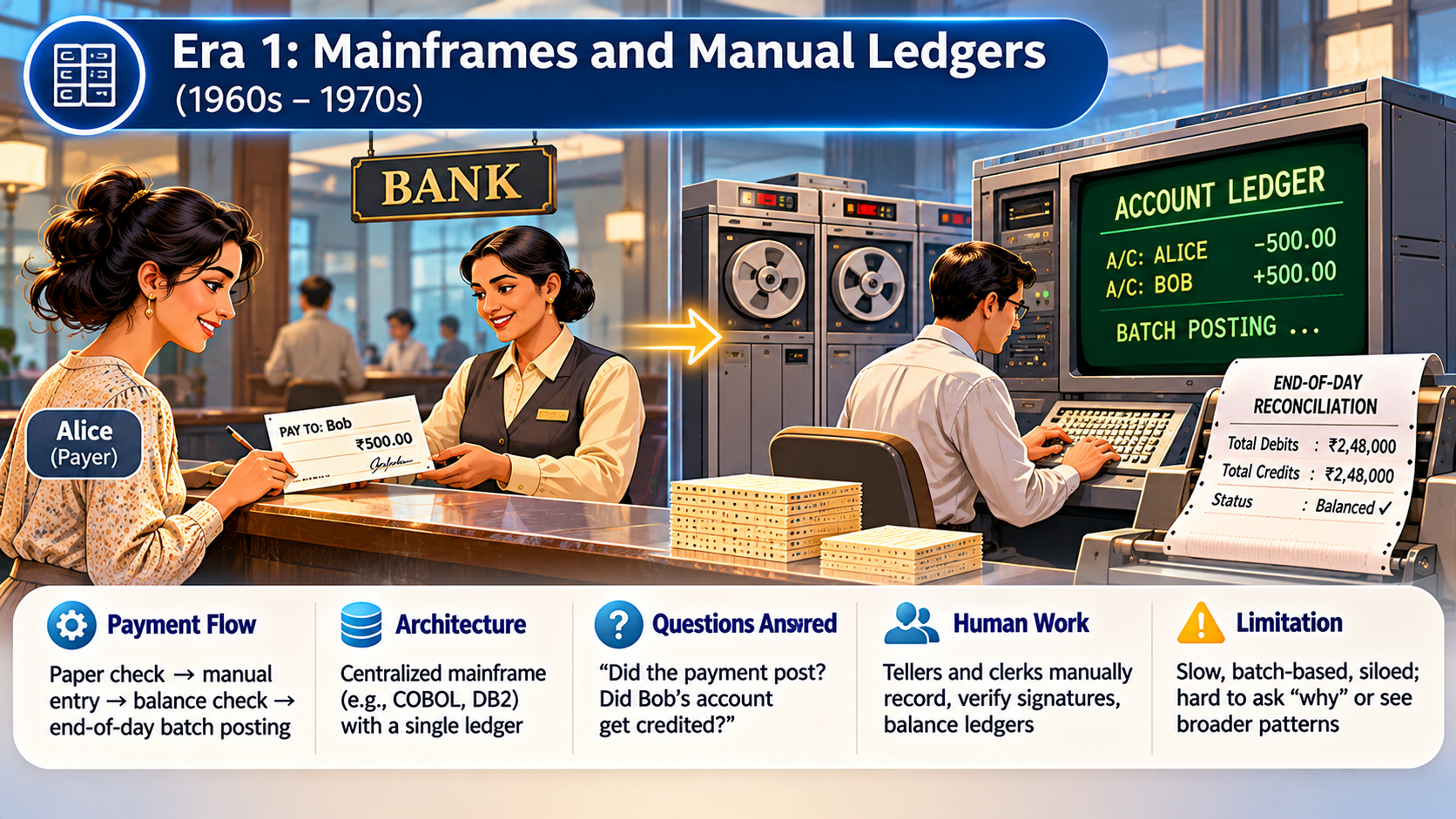
From paper cheques and manual entries to centralized mainframe ledgers.
Era 2: Relational Databases and OLTP (1980s--1990s)
When transactions became digital and immediate
Fast forward to the 1980s.
Alice no longer needs to visit the bank every time she wants to pay Bob.
She can use a card or an ATM. The transaction is initiated electronically and sent to the bank's transaction-processing system.
This is where relational database management systems (RDBMS) become central to enterprise applications.
Technologies such as Oracle and IBM DB2 enable organizations to store structured information in relational tables and process transactions using SQL.
The introduction and adoption of Online Transaction Processing (OLTP) fundamentally changed how businesses operated.
When Alice makes a payment, the application sends a request to the database. The system validates the transaction and updates the relevant account records.
The transaction is committed, and the application receives a response.
How did the architecture look?
- Relational databases such as Oracle and DB2.
- Structured schemas and SQL-based access.
- Online transaction processing.
- ACID transaction guarantees.
- Application-driven database operations.
- Separate reporting and analytical workloads beginning to emerge.
What questions could the business answer?
The focus moved beyond simply asking whether a transaction was recorded.
Businesses could now ask:
- Which payments happened today?
- How much did Alice spend?
- Which transactions were successful?
- How many payments were processed this week?
Organizations could query structured information and generate reports more efficiently.
Who did the cognitive work?
Database administrators designed schemas, managed database performance and maintained data integrity.
Application developers built transaction-processing systems, while analysts wrote SQL queries and generated business reports.
People still had to understand the business meaning of the information and investigate discrepancies.
What was the limitation?
Relational databases were excellent at managing structured transactions, but enterprise information was expanding beyond relational tables.
Different departments maintained different systems. Reporting workloads could compete with operational workloads, and combining historical information across systems required additional engineering.
The need to separate transaction processing from analytical processing became increasingly important.
This paved the way for data warehouses.
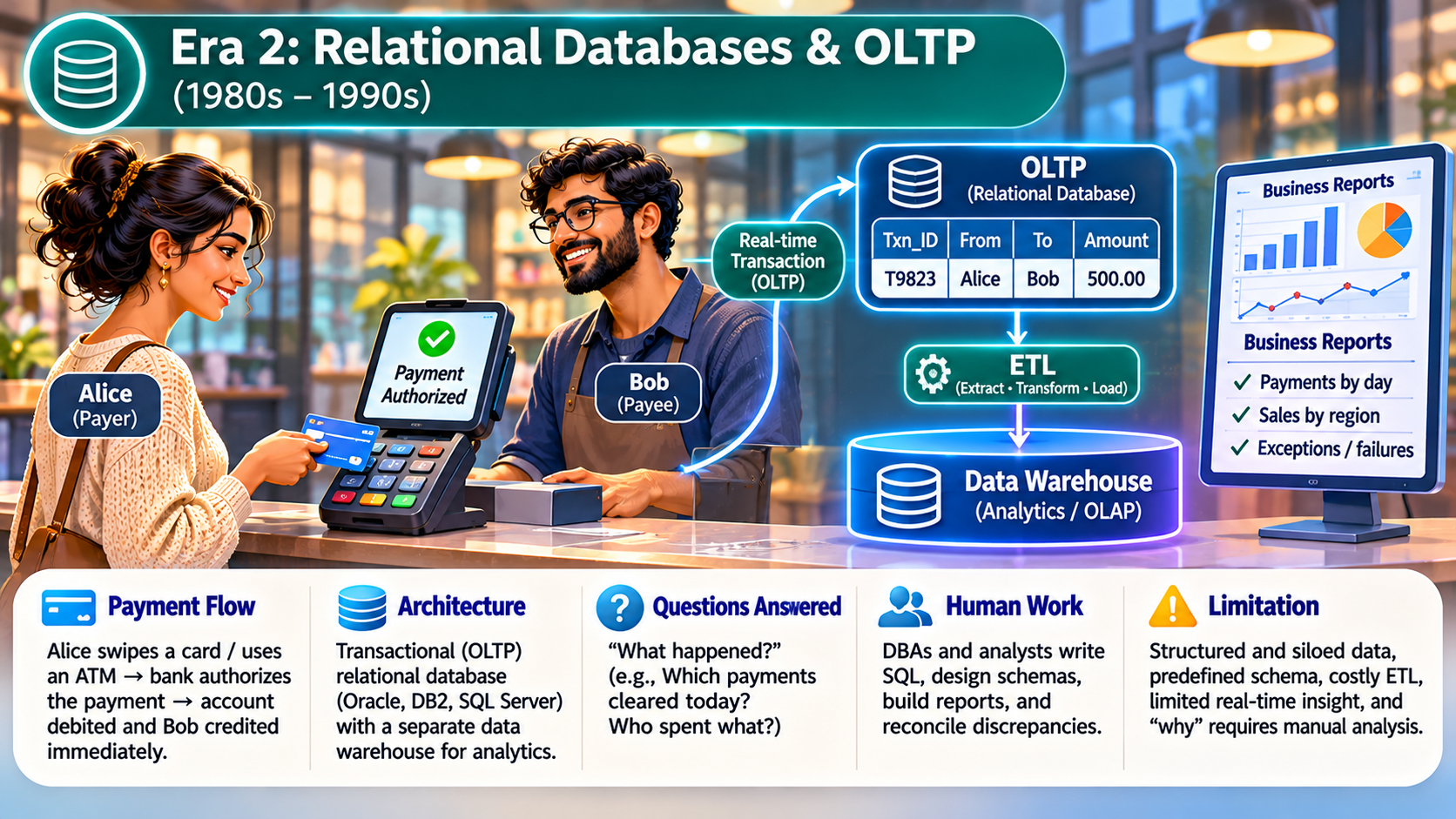
Electronic payments, relational databases and real-time transaction authorization.
Era 3: Data Warehouses and Enterprise Analytics (Late 1990s)
When organizations started asking: What happened?
As organizations grew, transactional systems accumulated enormous amounts of information.
But recording transactions was no longer enough.
Business leaders wanted to understand how the business was performing.
How much revenue did we generate? Which regions performed better? Which customers were spending more? What were the monthly payment trends?
This created the need for dedicated analytical platforms.
Data warehouses emerged as a way to consolidate information from multiple operational systems and make it available for enterprise-wide reporting and analysis.
The architecture introduced a clear separation between two important workloads:
OLTP --- Run the business.
OLAP --- Understand the business.
Alice's payment is still processed through an operational database. However, transaction information is periodically extracted, transformed and loaded into a data warehouse.
This is where ETL (Extract, Transform, Load) becomes an important part of enterprise data engineering.
Data from different branches, applications and business systems is integrated into a common analytical environment.
Analysts can now query historical information and generate business intelligence.
How did the architecture look?
- Operational relational databases.
- ETL pipelines.
- Enterprise data warehouses.
- OLAP and multidimensional analysis.
- SQL-based reporting and dashboards.
- Historical data consolidation.
What questions could the business answer?
- How many payments were processed this month?
- Which regions generated the highest transaction volumes?
- What are the customer spending trends?
- Which transactions are unusual?
- How has business performance changed over time?
Organizations could finally look beyond individual transactions and understand business-wide patterns.
Who did the cognitive work?
Data engineers built ETL pipelines and integrated information from multiple systems.
Database administrators optimized warehouse performance.
Business analysts created reports, dashboards and analytical models.
Accountants and operations teams investigated anomalies and reconciled discrepancies.
Technology was making information accessible, but humans were still responsible for interpreting the insights.
What was the limitation?
Traditional data warehouses were predominantly designed for structured data and analytical workloads.
ETL pipelines could be expensive and time-consuming to maintain. New data sources and unstructured information were difficult to accommodate.
Most importantly, organizations could understand what happened, but explaining why something happened still required considerable manual investigation.
As data volumes and varieties continued to grow, a new architectural approach was needed.
Enter Big Data.
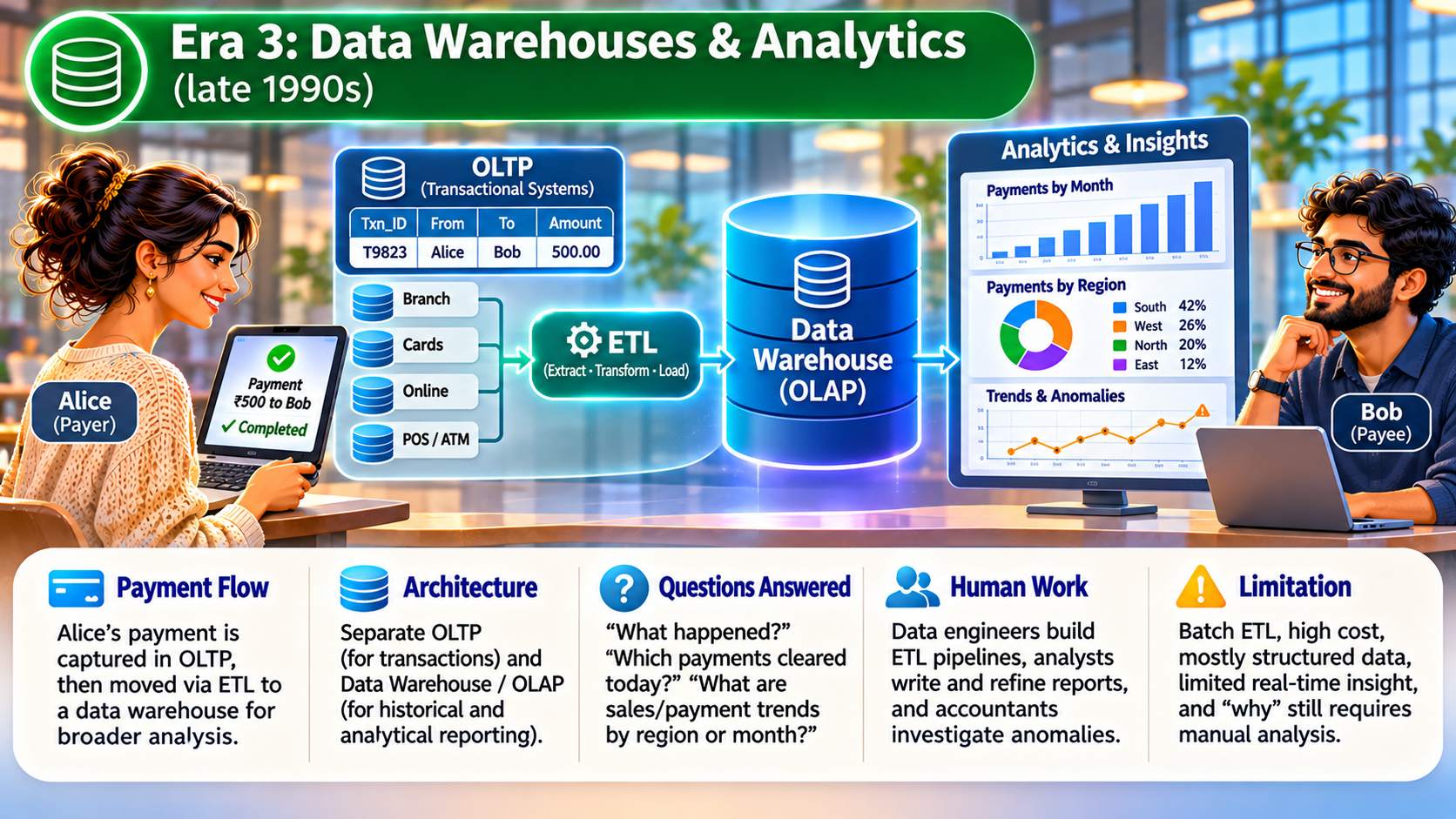
The separation of operational transaction processing and enterprise-wide analytical intelligence.
Era 4: Big Data, Hadoop, Spark and NoSQL (2000s)
When data became too big for traditional platforms
The 2000s brought an explosion of digital information.
Web applications, e-commerce, mobile platforms, clickstreams, application logs, documents and other machine-generated data started producing information at unprecedented scale.
Traditional data warehouses were not designed to efficiently handle every new data type and workload.
Organizations needed platforms that could store massive amounts of information, process it across distributed infrastructure and support more flexible data models.
This was the beginning of the Big Data era.
Technologies such as Apache Hadoop introduced distributed storage and processing through HDFS and MapReduce.
Apache Spark later made large-scale processing more flexible and efficient, particularly through in-memory computation.
At the same time, NoSQL databases such as Cassandra and MongoDB offered alternative data models for workloads that required flexibility and horizontal scalability.
Let's return to Alice's payment.
The transaction is still processed in real time by the bank. But now, the organization captures much more information around it.
- Where did Alice initiate the payment?
- Which device did she use?
- What was her previous spending behaviour?
- What happened during the session?
- Were there any suspicious activities?
- What did the application logs reveal?
The payment is no longer just a database record. It is one event among millions of interconnected data points.
How did the architecture look?
- Distributed storage using Hadoop HDFS.
- Distributed processing using MapReduce and Spark.
- NoSQL databases.
- Data lakes for storing structured and unstructured information.
- Batch and emerging streaming-processing architectures.
- Large-scale data engineering pipelines.
What questions could the business answer?
- Are there unusual patterns in Alice's transactions?
- Is this payment part of a broader customer behaviour trend?
- Can we identify potential fraud signals?
- What happens when we combine transaction data with application logs?
- Can we process large volumes of data across multiple channels?
Organizations began moving beyond traditional reporting into large-scale pattern discovery and predictive analytics.
Who did the cognitive work?
Data engineers designed distributed pipelines and managed large-scale processing systems.
Data scientists explored datasets, developed features and experimented with machine learning models.
Platform engineers managed clusters, storage and compute infrastructure.
The human cognitive burden shifted from manually reconciling transactions to designing algorithms, understanding patterns and interpreting increasingly complex datasets.
What was the limitation?
Distributed architectures introduced their own complexity.
Managing clusters, pipelines, data quality and multiple storage systems became operationally demanding.
Data lakes sometimes became data swamps. Organizations accumulated enormous amounts of information without necessarily understanding its quality, ownership or business meaning.
The question was no longer simply how to store and process more data.
It was how to make data platforms scalable, accessible, reliable and easier to operate.
Cloud-native platforms and the lakehouse architecture began addressing this challenge.
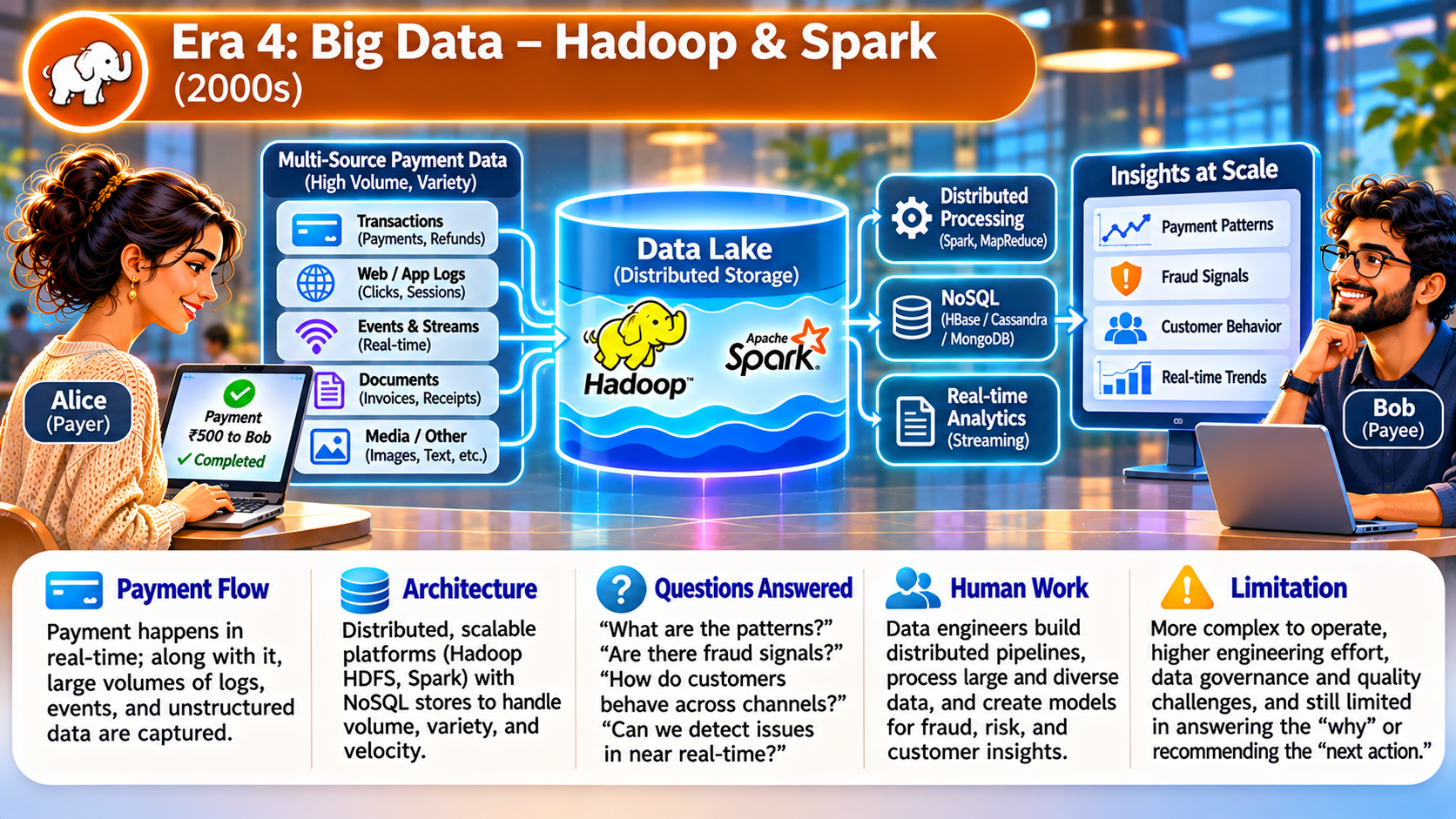
From structured transactions to distributed data lakes, large-scale processing and diverse data sources.
Era 5: Cloud Data Platforms, Lakehouses, Machine Learning and Generative AI (2010s--2020s)
When data started becoming intelligence
The next major shift came with cloud computing.
Organizations no longer needed to invest exclusively in large physical infrastructure to scale their data platforms.
Cloud platforms introduced elastic storage, scalable compute, managed services and more flexible consumption models.
Amazon Web Services, Microsoft Azure and Google Cloud became important foundations for modern enterprise data architectures.
The lakehouse architecture brought together capabilities traditionally associated with data lakes and data warehouses.
Open table formats, scalable object storage, analytical engines and streaming platforms enabled organizations to build increasingly unified data environments.
Technologies and platforms such as Amazon S3, Apache Spark, Delta Lake, Apache Iceberg, Snowflake and Databricks became part of this broader ecosystem.
Data engineering also matured.
Organizations adopted data quality frameworks, metadata management, data catalogs, lineage, governance and domain-oriented data products.
But another transformation was happening in parallel.
Machine learning was becoming a mainstream enterprise capability.
Instead of simply understanding historical payment patterns, organizations could start predicting what might happen next.
Alice's transaction could now be evaluated against historical behaviour, customer profiles, spending patterns and risk models.
The organization could estimate fraud probability, predict customer behaviour and recommend the next best action.
Then came Generative AI.
Large Language Models changed how people interacted with enterprise information.
Instead of writing complex SQL queries or navigating multiple dashboards, business users could increasingly ask questions in natural language.
Retrieval-Augmented Generation (RAG) allowed AI applications to retrieve relevant information from enterprise documents, knowledge bases and other data sources.
The conversation was changing.
How did the architecture look?
- Cloud-native data platforms.
- Data lakes and lakehouses.
- Batch and streaming pipelines.
- Open table formats such as Delta Lake and Iceberg.
- Data products and governed data access.
- Machine learning and predictive analytics.
- Foundation models and Generative AI.
- RAG and enterprise knowledge bases.
What questions could the business answer?
- Why did Alice make this payment?
- Is this transaction unusual given her historical behaviour?
- What is the likelihood of fraud?
- What is likely to happen next?
- Can we recommend the next best action?
- Can an AI system explain the transaction using relevant enterprise information?
The platform was evolving from analytical consumption towards intelligence.
Who did the cognitive work?
Data engineers built and maintained data pipelines and data products.
Data scientists trained and evaluated machine learning models.
ML engineers operationalized models.
AI engineers started building LLM-powered applications, RAG pipelines and intelligent assistants.
Business users increasingly interacted with enterprise information through conversational interfaces.
However, humans still interpreted recommendations, validated outputs and made important business decisions.
What was the limitation?
Despite all these advances, most enterprise AI applications were still primarily designed to retrieve information, generate insights and recommend actions.
The intelligence was improving, but execution remained largely dependent on people and existing application workflows.
An AI system could identify a suspicious payment, explain why it was suspicious and recommend an investigation.
But who would initiate the investigation?
Who would retrieve the relevant evidence, check the applicable policies, coordinate with other systems and execute the next step?
This brings us to the next architectural inflection point.
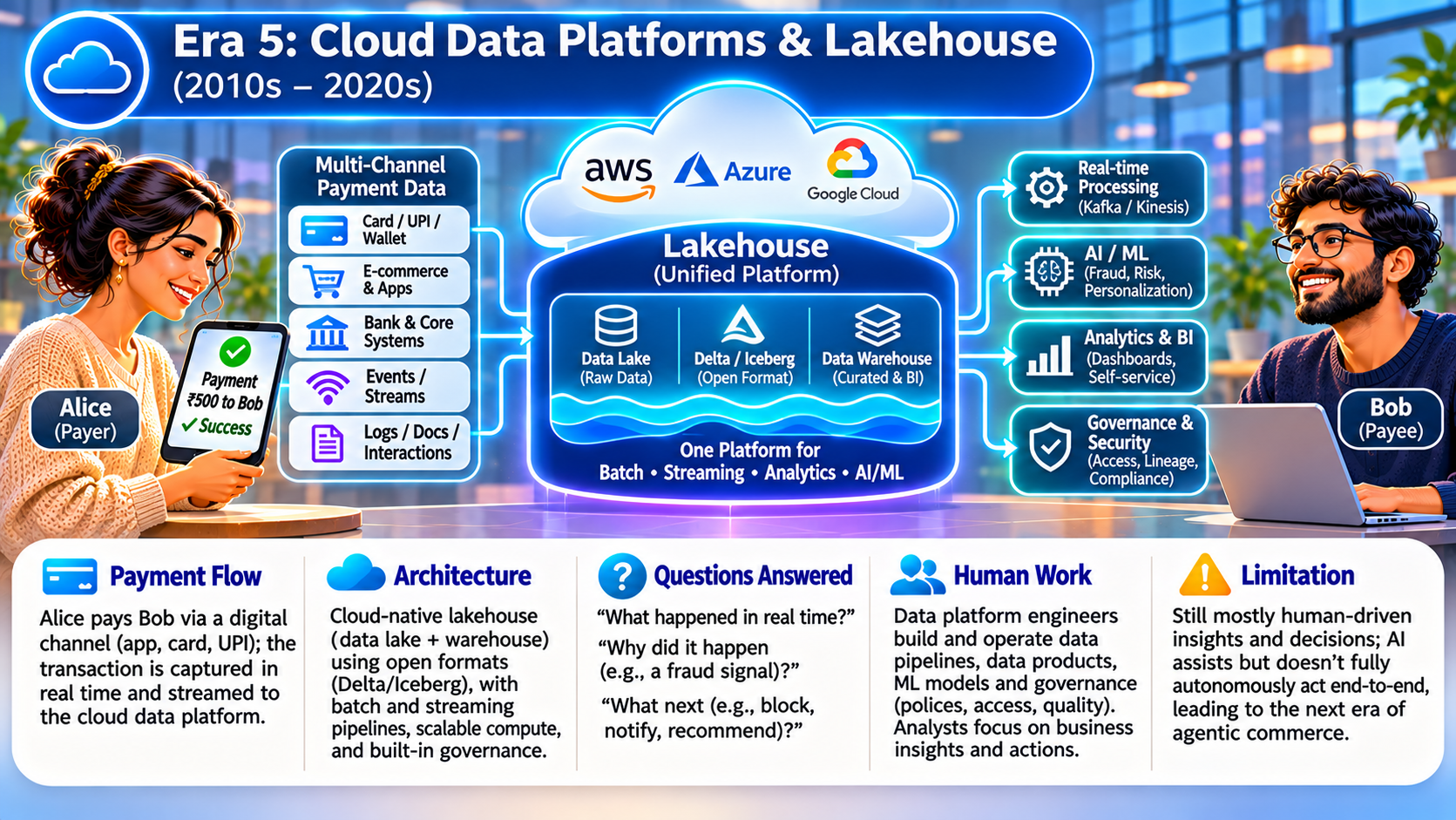
Cloud-native data foundations, unified lakehouses, machine learning and Generative AI.
Era 6: Agentic AI and Autonomous Commerce (2020s+)
When Alice no longer needs to execute every transaction
Imagine Alice wants to pay Bob ₹500 for a completed piece of work.
Instead of opening her banking application, entering the beneficiary details, checking the invoice and clicking the payment button, she simply delegates the task:
"Pay Bob ₹500 once the invoice is verified and the contractual conditions are satisfied."
Now the system needs to do much more than retrieve information or generate a recommendation.
An AI agent needs to understand Alice's intent, retrieve the relevant information, evaluate the conditions, establish its authority and interact with the underlying enterprise systems.
It may need to:
- Understand Alice's instruction.
- Retrieve Bob's details and the relevant invoice.
- Validate the contractual conditions.
- Check Alice's identity, permissions and payment limits.
- Evaluate risk and applicable policies.
- Execute the payment through an approved payment service.
- Reconcile the transaction and record the evidence.
- Notify Alice and Bob and initiate any required follow-up.
This is the emergence of agentic commerce.
The fundamental shift is that we are moving from human-initiated transactions towards goal-oriented, delegated execution.
There may also be multiple agents involved.
Alice's personal agent may interact with Bob's merchant agent. They may negotiate terms, exchange information, validate requirements and coordinate a transaction through approved payment infrastructure.
The payment itself becomes one step in a much larger intelligent workflow.
How does the architecture look?
- Cloud-native data and lakehouse foundations.
- Enterprise knowledge and context services.
- Foundation models and reasoning capabilities.
- AI agents and multi-agent orchestration.
- Enterprise APIs, tools and connectors.
- Identity and authorization services.
- Policy engines and guardrails.
- Execution traces, observability and audit.
- Human oversight and exception management.
What questions can the business answer?
The questions have fundamentally changed.
- What is Alice trying to accomplish?
- What information is relevant to this decision?
- Which business rules apply?
- Is the agent authorized to perform this action?
- What should happen next?
- Can the transaction be executed safely?
- What evidence should be recorded?
- Who needs to be involved if an exception occurs?
Who does the cognitive work?
Humans increasingly define business intent, establish policies, delegate responsibilities and monitor outcomes.
AI agents retrieve information, reason within defined boundaries, coordinate workflows and execute approved actions.
Platform engineers build the infrastructure that allows agents to operate securely.
Data and AI engineers ensure that the agents have access to trusted, relevant and current enterprise context.
Governance teams establish the policies, permissions and accountability mechanisms required for responsible autonomy.
What are the new limitations?
Autonomous systems introduce a different class of challenges.
- How do we establish trust in an agent's identity?
- How do we prevent unauthorized actions?
- How do we ensure that decisions are grounded in current enterprise information?
- How do we enforce business policies before execution?
- How do we reconstruct the reasoning, evidence and actions?
- How do we recover from failed or incorrect actions?
The challenge is no longer simply building an intelligent system.
It is building an intelligent system that can operate within an enterprise safely, reliably and at scale.
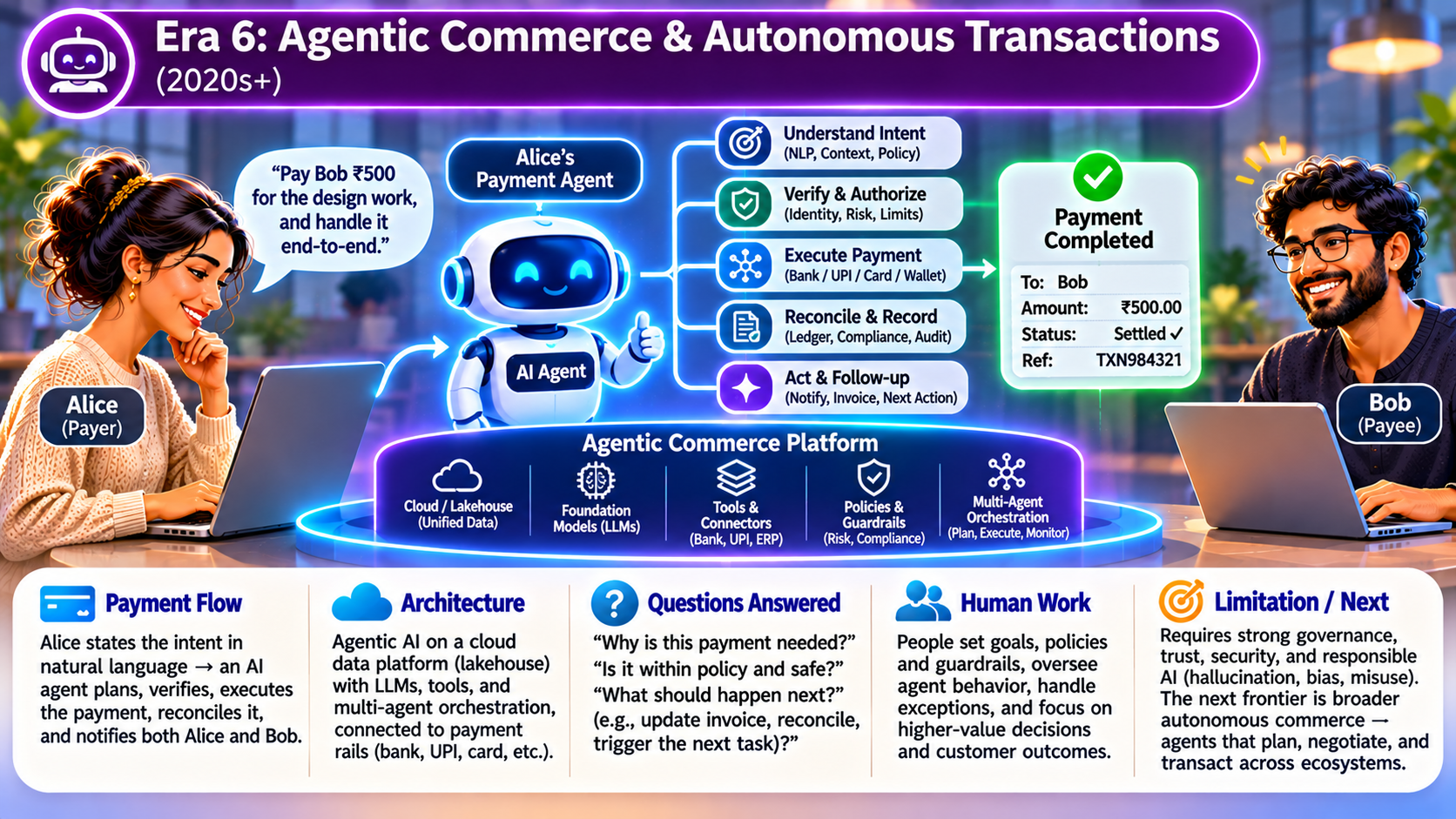
Alice delegates the task. Her agent understands, verifies, executes and reconciles the transaction under defined policies.
The Evolution of Questions: From Recording Transactions to Autonomous Decisions
Looking back across these six eras, one thing becomes clear.
The evolution of data platforms is not just about storage, processing power or newer technologies.
It is also about the evolution of the questions businesses can ask and the cognitive work that technology can take on.
Era Primary focus The question
Era 1 --- Mainframes Recording Did the payment happen?
Era 2 --- Relational Transaction processing Was the payment DBs processed?
Era 3 --- Data Reporting What happened? Warehouses
Era 4 --- Big Data Pattern discovery Why did this pattern occur?
Era 5 --- Cloud, ML and Intelligence What does it mean? What GenAI is likely next?
Era 6 --- Agentic AI Autonomous action What should happen next, and who is authorized to act?
The role of people evolved alongside the architecture.
We moved from tellers and bookkeepers to database administrators, data engineers, data scientists, ML engineers and AI engineers.
Now, we are entering a world where humans increasingly define objectives and constraints while intelligent systems execute well-defined workflows.
But there is something important to recognize.
Every new generation was built on the capabilities of the previous generation.
We did not abandon databases when data warehouses emerged.
We did not abandon data warehouses when data lakes arrived.
We did not abandon data lakes when cloud lakehouses became mainstream.
Similarly, Agentic AI will not make modern data platforms irrelevant.
It will make them even more important.
The question is how we evolve those foundations to support a fundamentally different kind of consumer: an intelligent system that needs to understand, decide and act.
The Next Challenge: Modern Data Engineering for the Agentic Era
We have spent decades building platforms that collect, store, transform, govern and serve enterprise data.
We have become increasingly sophisticated at moving data across systems, managing pipelines, building data products and enabling analytical consumption.
We have invested in cloud platforms, lakehouses, streaming infrastructure, machine learning and Generative AI.
Yet, as we enter the agentic era, an important architectural question emerges:
Are our modern data platforms and engineering practices actually designed for autonomous intelligence?
If foundation models become increasingly accessible to everyone, what will make one organization's AI capabilities fundamentally better than another's?
My view is that the answer lies in its proprietary enterprise data, accumulated knowledge and the context it can provide to intelligent systems.
We spent decades learning how to manage data.
The next decade will be about engineering the context that enables enterprises to think, decide and act.
Coming Next: Part II --- Beyond the Modern Data Platform: Engineering Context for the Agentic Era
In Part II, we will explore what this architectural shift means for enterprise data engineering and platform strategy.
We will go deeper into:
- Why traditional data engineering is no longer sufficient for autonomous intelligence.
- Why Context Engineering needs to become a first-class enterprise capability.
- Why proprietary enterprise data and knowledge are becoming the real competitive moat.
- How to evolve the modern data platform into a context-driven architecture.
- How AWS services such as Amazon S3, Glue, Lake Formation, Bedrock and Bedrock AgentCore can help establish this foundation.
- How enterprises can build reusable context services, shared agent infrastructure and governance capabilities at scale.
- How to move from AI experimentation to controlled autonomy and measurable business outcomes.
We will also explore an important architectural principle:
Data is the moat. Context is how we unlock its value. Decisions and outcomes are how we realize that value.
The journey from Alice paying Bob to an autonomous agent paying Bob is not simply the evolution of payment technology.
It is the evolution of how enterprises understand their business and turn that understanding into action.
The next chapter is about engineering that capability.
End of Part I
Part II: Beyond the Modern Data Platform --- Engineering Context for the Agentic Era.
About the author
- I'm Ayyanar Jeyakrishnan ; aka AJ. With over 21 years in IT, I'm a passionate Multi-Cloud Architect specialising in crafting scalable and efficient cloud solutions. I've successfully designed and implemented multi-cloud architectures for diverse organisations, harnessing AWS, Azure, and GCP. My track record includes delivering Machine Learning and Data Platform projects with a focus on high availability, security, and scalability. I'm a proponent of DevOps and MLOps methodologies, accelerating development and deployment. I actively engage with the tech community, sharing knowledge in sessions, conferences, and mentoring programs. Constantly learning and pursuing certifications, I provide cutting-edge solutions to drive success in the evolving cloud and AI/ML landscape.
Comments
Join the discussionNo comments yet. Be the first to comment.